The Third Testament: Rewriting Faith Beyond the Bible
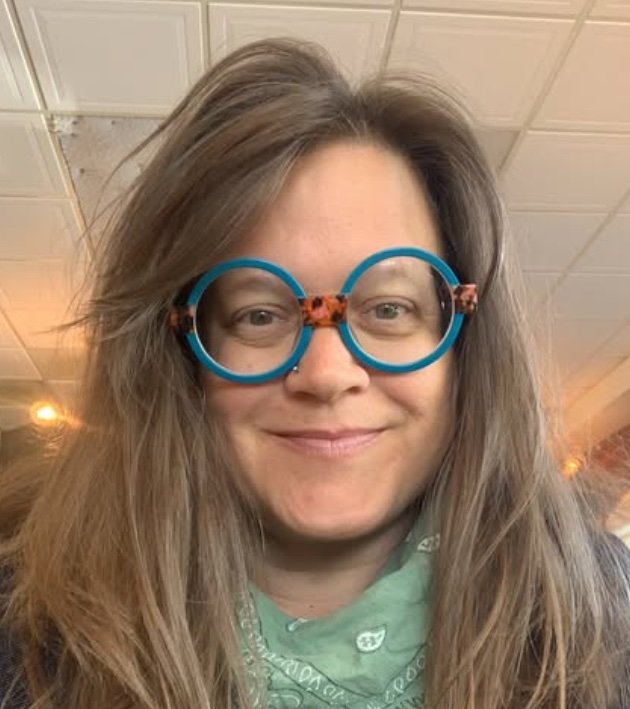
By Julie Davis, Community Pastor at Central Avenue Church
A couple of years ago, when Joe Biden was still president and the possibility of a second Trump administration felt increasingly real, I attended a conference hosted by the Yale Center for Public Theology and founded by Rev. Dr. William J. Barber II. Clergy, scholars, and activists gathered to study Project 2025 and imagine both how we might prevent it from becoming reality and how we would respond if it did.
In many ways, we were preparing for the world we are living in now.
The conference was emotionally and spiritually exhausting. Not just because of the gravity of what we were discussing, but because of the profound sense of hope and energy that pulsed through every gathering.
I still remember the first night of worship.
It was my first time at Yale University, and I was struck by the beauty of the campus and the historic church standing right on the New Haven Green. As we sang and clapped, I glanced to my side and realized I was worshiping alongside philosopher, theologian, political activist, and politician Cornel West. For a moment, he was simply another congregant, singing and praising God with the rest of us.
Later, Dr. Barber took the stage. If you’ve ever seen him, you know he is physically imposing, and because of chronic health challenges, his body often appears rigid. But during worship, he suddenly began to move and dance with surprising fluidity. It felt as though something sacred was sweeping through the room.
And then came the moment that changed me.
Meeting Bishop Yvette Flunder
At the close of the conference, Yvette Flunder spoke.
Bishop Flunder is the founder of the Fellowship of Affirming Ministries and senior pastor of City of Refuge United Church of Christ. I had heard of her, but I had never experienced her preaching firsthand.
The moment she began speaking, everyone else on the panel faded into the background.
She preached about what she called a Third Testament.
As a Black lesbian bishop, she described her own body as a living testament to God’s ongoing revelation, a witness to divine love that extends beyond the limitations of ancient texts shaped by patriarchy, homophobia, and empire.
Her words were electric.
I don’t use the phrase “Holy Spirit” casually, but that is exactly what it felt like.
When the conference ended, I carried that idea home with me: What if God is still speaking through our lives? What if revelation did not stop when the biblical canon was closed?
“The Bible Is Words About God”
When Bishop Flunder revisited this idea recently, some corners of the Christian world reacted with outrage.
But her core insight resonated deeply with me: The Bible is not the Word of God. It is words about God.
That distinction matters.
The Bible contains beauty, wisdom, and truth. It also contains texts that have been used to justify slavery, misogyny, homophobia, racism, and ecological destruction.
If we are honest, every generation wrestles with scripture.
That is what faith has always been.
The name Israel itself is often understood to mean “one who wrestles with God.” Our tradition invites us into that struggle.
Deconstruction and the Limits of Language
This way of thinking is not as radical as some might assume.
In the 1960s, French philosopher Jacques Derrida argued that no text has a single, fixed meaning. Language is always interpreted through context, culture, and experience.
Meaning shifts.
Texts contain contradictions.
Readers bring their own assumptions.
In other words, all language is human language.
Even scripture.
That does not make the Bible worthless. It simply means that no text is perfect, timeless, or immune from interpretation.
The existence of a New Testament already demonstrates this principle. Early Christians believed they needed a new way to understand God in light of Jesus.
Why should we assume God stopped speaking then?
Why We Need a Third Testament
When I speak of a Third Testament, I am not suggesting we write a new Bible.
If we have learned anything from history, it is that texts can become tools of domination when they are treated as unquestionable authority.
What we need is not another rigid canon.
What we need is a living, evolving way of embodying the spirit of Christ.
The pattern Jesus gave us is simple:
Incarnation
Death
Resurrection
Transformation
Spirit
The Third Testament is written whenever we embody that pattern in our own lives.
It takes shape when we incarnate compassion, justice, courage, and love.
It is not written on paper.
It is written in relationships.
What Guides Me Now in My Journey of Deconstruction & Reconstruction
As I continue my own journey of deconstruction and reconstruction, I have found guidance in several places beyond traditional scripture.
The Eight C’s of Internal Family Systems
Internal Family Systems Model offers eight qualities of a grounded and healthy self:
Curiosity
Compassion
Calm
Clarity
Courage
Confidence
Creativity
Connectedness
These are deeply spiritual virtues. They help us respond from wisdom rather than fear.
Emergent Strategy
I also draw inspiration from Emergent Strategy: Shaping Change, Changing Worlds by Adrienne Maree Brown.
In her book, Brown explores how small, intentional interactions can create large-scale transformation. Instead of competition and hierarchy, she imagines systems rooted in collaboration, adaptation, and trust.
Her work is influenced by Octavia E. Butler, who famously wrote:
“There is nothing new under the sun, but there are new suns.”
That line gives me hope.
Perhaps the future of faith is not about preserving old hierarchies, but about discovering new sources of energy, imagination, and connection.
Learning from the Birds
Adrienne Maree Brown often points to nature as our teacher.
Birds do not hold strategic planning meetings before migration. They feel a call within them and follow it.
As they migrate, they find the resources they need and, in turn, help heal ecosystems by pollinating plants, dispersing seeds, and controlling pests.
Emergence works the same way. Simple acts of faithful response can transform entire systems.
The health of the flock contributes to the health of the world.
Following Our Calling
This reminds me of a quote from Frederick Buechner that I have loved for years:
“The place God calls you to is the place where your deep gladness and the world’s deep hunger meet.”
What if we all lived from that place?
What if we paid attention to where we feel most alive and allowed that calling to guide us?
What if our faith was less about defending old texts and more about becoming living witnesses to God’s liberating love?
Writing the Third Testament Together
At Central Avenue Church in Pasadena, I believe this is exactly what we are doing.
Together, we wrestle with scripture and tradition.
We honor what is life-giving.
We question what causes harm.
And we seek to embody something more whole, more just, and more loving.
The Third Testament is not a book.
It is the story we write with our lives when we allow the spirit of Christ to take flesh in us.
Every act of compassion.
Every pursuit of justice.
Every relationship rooted in courage and connectedness.
These are the pages of the Third Testament.